
Diversity, Equity, and Inclusion Training for Healthcare Professionals
DEI training for healthcare professionals teaches clinical and non-clinical staff to spot implicit bias, communicate across cultures and languages, and give every patient equitable care. Diversity Builder has taught these skills since 2003. We work with more than 500 organizations nationwide through instructor-led, virtual, and online courses that also support state licensing requirements.
Certifications and memberships


Talk with our team about the best DEI training solution for your healthcare organization.
Why Does DEI Training Matter in Healthcare?
Bias and communication gaps affect diagnosis, treatment, and trust.
During the pandemic, The Joint Commission reported that Black and Hispanic patients with COVID-19 experienced nearly three times the hospitalization rate of White patients [2]. Nobody on a care team wants to contribute to a gap like that. Training gives staff tools to close the gaps they can actually influence.
The workforce case is just as real. Press Ganey found that healthcare organizations risk losing about twice as many employees when staff feel the organization doesn’t value people from different backgrounds [3]. Hospitals are competing hard for nurses, techs, and support staff right now. Retention is a money issue, not a feel-good one.
There’s also a demographic reality to name. The National Council of State Boards of Nursing workforce survey found that about 80 percent of U.S. nurses are White and roughly 9 percent are men [4], while the patient population continues to grow more diverse. When teams and patients differ, communication skills have to carry more of the load. That’s a training problem, and training problems can be solved.
What Training Logistical Challenges Do Healthcare Organizations Face?
After two decades of this work, Diversity Builder has observed some common trends: staff who felt singled out in a past training, schedules with no room for a half-day class, and skills learned that never made it from the classroom to the healthcare workplace. Leaders play a significant role in being change catalysts by supporting the training and continuing the conversation with an implementation phase.
Here is how those challenges show up in real facilities:
Training fatigue. Clinicians who sat through a lecture-style module often arrived skeptical. Interactive, case-based learning changes that experience.
Scheduling around patient care. A 24/7 operation cannot send everyone to the same session. Mixed delivery, live plus self-paced, keeps units covered.
Uneven starting points. A charge nurse, a lab tech, and a front desk coordinator need different scenarios. Role-based content meets each learner where they work.
Legal and regulatory change. Federal policy on DEI shifted in 2025, while many state licensing mandates remain in force. Programs must be reviewed for current legal compliance and focused on patient care skills and respectful workplace behavior.
Proving results. Boards ask what the organization received for its training spend. Assessments and follow-up coaching answer that question with data.

Mission, Vision, and Core Values
What
Diversity Builder reinforces healthcare organization’s mission and core values within the training. An example of some healthcare core value from a California health care hospital system client is listed below for reference.
How
Teamwork
Valuing and cultivating the contributions of team members, academic institutions, and community and corporate partners.
Respect
Embracing diversity and treating one another and those served with dignity and compassion.
Integrity
Upholding the highest standards of professionalism, ethics, and fiscal accountability through a commitment to confidentiality, public trust, and transparency.
Excellence
Striving for the best in everything done, with a commitment to continuously improving quality, safety, and service.
Discovery
Welcoming innovative ideas and promoting learning to provide the latest advancements in healthcare and technology.
How the Training Works
Assess
We interview your stakeholders and review your policies before anything is written.
Customize
Scenarios are adapted to your care and work setting, roles, and any applicable requirements.
Train
Role-play, case studies, and action planning in every live session, on-site, virtual, or self-paced.
Measure
Pre and post-assessments, participant ratings, and optional 60 to 90 day follow-ups.
What Will Participants Learn?
Participants learn to recognize how unconscious bias forms, interrupt it in clinical decision-making, communicate with patients across cultures and languages, and respond to microaggressions professionally. Every session uses healthcare scenarios, so a nurse practices a patient handoff and a scheduler practices an interpreter request, not abstract theory.

Course Curriculum
Foundations of diversity, equity, and inclusion in healthcare.
Clear definitions, why terms matter, and how equity connects to quality and safety goals.
Implicit and unconscious bias in clinical care.
How associations form, where they influence triage, pain management, and documentation, and evidence-based ways to reduce their effect.
Cultural competence and cultural humility.
Practical frameworks for asking about beliefs, family roles, and health practices without stereotyping.
Patient communication and language access.
Working with qualified interpreters, teach-back methods, plain language, and trauma-informed communication.
Microaggressions and respectful workplace behavior.
Recognizing subtle slights, responding as a bystander, and repairing team trust.
Disability, age, and LGBTQ+ inclusion in care settings.
ADA awareness, accessible service, pronoun use, and inclusive intake practices.
Psychological safety and inclusive leadership.
How charge nurses, managers, and physicians create teams where people speak up about safety concerns.
Action planning.
Each participant leaves with two or three specific commitments tied to their role.
Training Objectives
Understand the Importance of Cultural Competency in Healthcare:
- Explain why cultural competency is critical in healthcare settings, particularly in preventing violence and trauma.
- Explore how cultural misunderstandings, biases, and stereotypes can contribute to miscommunication, leading to violence or trauma.
Recognize and Address Implicit Biases and Power Dynamics:
- Teach participants how to recognize and address implicit biases and power imbalances that may impact interactions with marginalized groups.
- Discuss the role of intersectionality in identity and how it can exacerbate trauma or lead to violence.
Equip Participants with Practical Strategies for Culturally Competent, Trauma-Informed Care:
- Provide tools and strategies to integrate cultural competency into trauma-informed care, fostering trust and rapport with diverse populations.
- Teach effective communication techniques tailored for clients from various cultural backgrounds to prevent the escalation of violence.
Implement Culturally Affirming De-escalation Techniques:
- Demonstrate methods to de-escalate potentially violent situations in a culturally sensitive manner, while promoting a supportive and safe environment for both staff and clients.
Talk with our team about the best DEI training solution for your healthcare organization.
Skills Developed
- Bias interruption techniques for clinical and administrative decisions
- Cross-cultural interviewing and teach-back communication
- Bystander responses to disrespectful comments from colleagues or patients
- De-escalation basics, expanded in our healthcare de-escalation and conflict mediation training
- Inclusive documentation and intake practices
- Team communication habits that support psychological safety
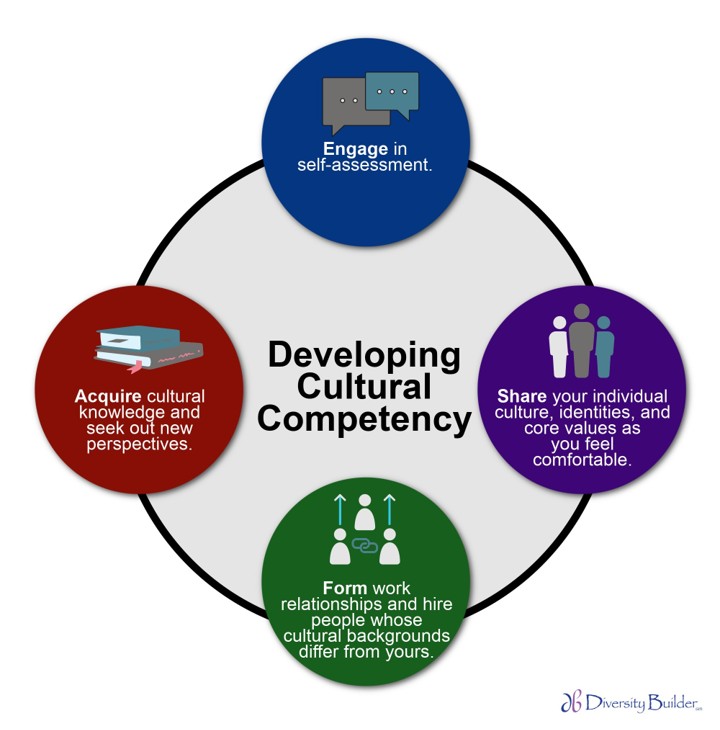
The Diversity Builder CARE Framework for Inclusive Patient Interactions
Our trainers teach a four-step method that any staff member can apply in under a minute:
C: Check assumptions.
Pause and name what you are assuming about this patient or colleague before you act.
A: Ask, do not guess.
One respectful question replaces a stereotype. “What should our team know to take good care of you?”
R: Respond to the person.
Adjust communication, language services, or accommodations to what you heard.
E: Elevate and follow through.
Document needs, brief the next shift, and speak up when the system falls short.
Participants practice CARE through role-play in every instructor-led session, so the method survives contact with a busy Tuesday.
Who Should Attend This Training?
Everyone who touches the patient experience benefits, from physicians and nurses to front desk staff and executives. Bias and communication gaps do not stop at clinical roles. A registration error, a billing conversation, or a security interaction shapes patient trust as much as an exam does.
We tailor scenarios for these healthcare roles and settings:
Clinical teams: physicians, nurses, medical assistants, pharmacists, laboratory staff, dental teams, behavioral health providers, and therapists
Patient-facing support: front desk and registration, schedulers, patient experience teams, case managers, and interpreters’ clinical partners
Leadership and operations: executives, administrators, HR professionals, department managers, and charge nurses
Settings: hospitals, clinics, long-term care and skilled nursing, home health, public health departments, payers, and academic medical centers
Does DEI Training Meet Compliance and Licensing Requirements?
In several states, yes, training in implicit bias or health equity is tied to healthcare licensure. Michigan requires implicit bias training for most licensed health professionals [5]. California, Kentucky, Illinois, Washington, Massachusetts, and Maryland have their own requirements. Rules change often, so verify details with your licensing board before you rely on them.
Michigan
Implicit bias training for professions licensed under the Public Health Code: two hours for new licensees and continuing annual training for renewal under rule R 338.7004 [5]. See our Michigan implicit bias training page.
California
Implicit bias content required in continuing medical education; newly licensed nurses must complete an approved implicit bias course within their first two years under AB 1407 [6].
Maryland
2025 legislation requires approved implicit bias and structural racism training at the first license renewal after April 1, 2026 [7].
Kentucky
Nurses complete a minimum of 1.5 contact hours of implicit bias education as part of continuing competency [8].
Illinois
One hour of implicit bias awareness training within continuing education for licensed professionals [8].
Washington
Health equity continuing education required for licensed health professionals [8].
Two other compliance threads matter for organizations:
Language access. Section 1557 of the Affordable Care Act requires covered entities to provide meaningful access for patients with limited English proficiency, including qualified interpreters [9]. Training staff to use interpreter services correctly is a direct compliance support.
A changed federal landscape. CMS removed its hospital commitment to health equity structural measure and social drivers of health screening measures from inpatient quality reporting in the fiscal year 2026 final rule [10], and 2025 federal executive actions ended DEI programs in federal agencies. Many competitor pages still cite the older CMS measures. State licensing mandates, civil rights laws such as Title VI and Title VII, the ADA, and Section 1557 continue to apply. We design training to focus on lawful, skills-based patient care and respectful conduct, and we recommend that your counsel review program framing, as we are trainers, not attorneys.
What Are the Benefits of Diversity and Inclusion in Healthcare Organizations?
The benefits of diversity in healthcare show up in retention, teamwork, and patient experience. Staff who feel valued stay longer, and Press Ganey’s finding that perceived neglect of inclusion doubles turnover risk puts a number on that [3]. Patients who feel understood share better information, which supports diagnosis and adherence.
- Retention and engagement. Inclusion is a stay factor in exit and engagement surveys across the industry [3].
- Safer teams. Psychological safety helps staff raise safety concerns before they become events.
- Better patient communication. Interpreter use, teach-back, and cultural humility reduce misunderstandings that drive readmissions and complaints.
- Stronger community trust. Organizations that serve their whole community well earn reputation and volume.
- Compliance readiness. Trained staff supports language access obligations and state licensure requirements [5][9].
Why Choose Diversity Builder for Healthcare DEI Training?
Because we have done this work since 2003. Diversity Builder is a Nashville-based, women-owned training company serving more than 500+ organizations nationwide across healthcare, corporate, nonprofit, government, and education sectors. Our nationwide team of professional trainers brings facilitation experience, not slide decks read aloud.
- 23 years of workplace training experience, founded in 2003
- Healthcare fluency: scenarios built for clinical workflows, from bedside to billing
- Customization as standard: we interview your stakeholders, review your policies, and adapt every case
- Skills-based, interactive methods: role-play, case studies, and action planning in every live session
- Full delivery range: on-site, live virtual, webinar, coaching, and self-paced online
- Accessibility: captioned virtual sessions, accessible materials, and accommodations on request, consistent with ADA and WCAG-informed practices
- Certificates of completion for participants and rosters for your compliance records
Case Study: Addressing Language Barriers in a Culturally Sensitive Way
Maria (she/her), a 35-year-old Latina immigrant, comes to a clinic with recurring headaches and abdominal pain. She is accompanied by her husband, who acts as her interpreter. During the visit, Maria is quiet and avoids eye contact, and her husband answers most of the questions on her behalf. The healthcare provider notices that Maria seems tense and hesitant when asked about her symptoms. The provider suspects that there might be more to Maria’s situation, possibly involving domestic violence.
- What are the risks of using family members as interpreters, particularly in cases involving potential violence or trauma?
- How can a provider ensure that a patient like Maria feels safe and empowered to speak about her situation?
- What steps should the provider take to build trust and de-escalate any tension in this situation?
Case Study 2: Navigating Cultural Attitudes Towards Authority
Ahmad (he/him), a 22-year-old refugee from Syria, visits a mental health clinic with complaints of insomnia and anxiety. He is accompanied by a friend who translates for him. Ahmad is reluctant to discuss his past, and when asked about his experiences in Syria, he becomes agitated and defensive. He mentions distrust of authorities due to previous traumatic encounters with government officials in his home country.
- What are the risks of using family members as interpreters, particularly in cases involving potential violence or trauma?
- How can a provider ensure that a patient like Maria feels safe and empowered to speak about her situation?
- What steps should the provider take to build trust and de-escalate any tension in this situation?

Frequently Asked Questions About Healthcare DEI Training
Is DEI or implicit bias training required for healthcare workers?
It depends on your state and profession. Michigan, California, Maryland, Kentucky, Illinois, and Washington tie implicit bias or health equity training to licensure or continuing education for many health professions. Requirements vary by board and change over time, so confirm current rules with your state licensing board.
Can the training be customized for our hospital or clinic?
Yes. Customization is standard for our instructor-led programs. We adapt scenarios to your care setting, roles, policies, and any applicable state requirements, and we can incorporate your patient experience or engagement data into the design.
What is the difference between DEI training and cultural competence training?
Cultural competence training focuses on communicating effectively across cultures, mainly in patient interactions. DEI training is broader: it includes cultural competence plus implicit bias, equity concepts, inclusive teamwork, and respectful workplace behavior among colleagues. Many healthcare organizations run both, since the skills reinforce each other.
How do you measure whether the training worked?
We use pre and post-assessments of knowledge and confidence, participant relevance ratings, and optional 60 to 90 day follow-ups. Organizations can also track patient experience comments, grievance themes, and interpreter utilization over time to watch for movement on the metrics training can influence.
Do participants receive a certificate?
Yes. Participants receive a certificate of completion, and your organization receives attendance rosters for training records. If you need training to satisfy a specific state licensing requirement, tell us the state and profession first, and we will confirm fit before you schedule.
How much does healthcare DEI training cost?
Pricing depends on format, group size, number of sessions, and customization depth. On-site workshops, virtual sessions, and self-paced licenses are quoted separately. Contact us with your headcount and goals, and we will provide a clear quote, usually within two business days.
Ready to Build a More Inclusive Care Team?
Talk with our team about the best DEI training solution for your healthcare organization.
Sources
- Agency for Healthcare Research and Quality. National Healthcare Quality and Disparities Report series. ahrq.gov/research/findings/nhqrdr (accessed July 2026).
- The Joint Commission. Report on COVID-19 hospitalization disparities, November 2021, cited in coverage of the 2023 health equity accreditation requirements.
- Press Ganey. Workforce engagement research on diversity, equity, and inclusion in healthcare, 2021.
- National Council of State Boards of Nursing. National Nursing Workforce Survey findings on nurse demographics, 2022.
- Michigan Department of Licensing and Regulatory Affairs. Public Health Code General Rules, R 338.7004 implicit bias training standards, effective June 2022.
- California Board of Registered Nursing. Implicit bias course requirement under AB 1407, effective January 1, 2023.
- Maryland Department of Health and Maryland Board of Nursing. Implicit bias and structural racism training requirements under 2025 legislation (HB 783), effective for renewals after April 1, 2026.
- State licensing summaries: Kentucky Board of Nursing continuing competency requirements (effective July 1, 2022); Illinois continuing education implicit bias awareness requirement; Washington State health equity continuing education requirement.
- U.S. Department of Health and Human Services. Section 1557 of the Affordable Care Act, nondiscrimination and language access provisions.
- Centers for Medicare and Medicaid Services. Fiscal year 2026 IPPS final rule, July 2025, removing the hospital commitment to health equity and social drivers of health measures from inpatient quality reporting.
- Weller LH, et al. Lessons learned from implementing a diversity, equity, and inclusion curriculum for health research professionals. Journal of Clinical and Translational Science, 2024.