
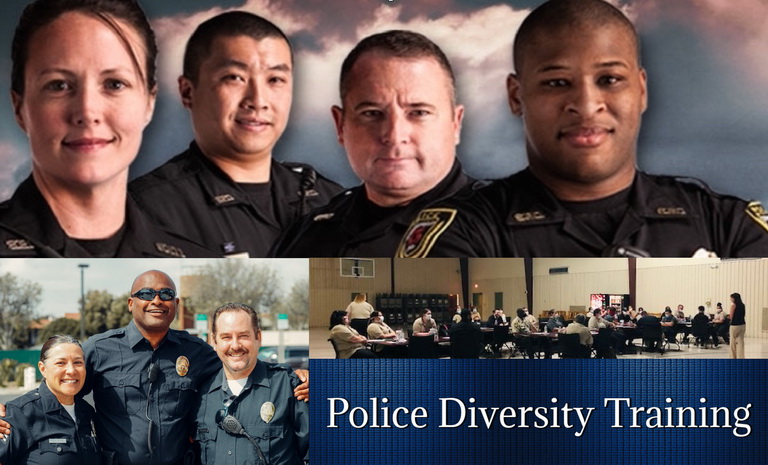
Law enforcement agencies face unique diversity challenges – from community trust to internal culture. Our Police Diversity Training equips officers and leadership with the cultural competency skills needed to serve diverse communities with fairness, empathy, and professionalism.
Training topics include unconscious bias in policing, cross-cultural communication, de-escalation through cultural awareness, and building community trust. Sessions are available onsite, online, or as webinars, and are tailored to your department’s specific context and challenges.
Delivered by certified trainers with experience in law enforcement environments, our programs meet the growing demand for accountability and community-centered policing.
Cultural Competency Law Enforcement
Diversity Builder has developed a highly engaging police diversity training program entitled Keeping the Peace: Policing Diverse Communities. It has been facilitated for several departments including the City of Akron, Ohio’s Police Department, the Birmingham, Alabama Police Academy, Sonoma County Sheriff’s Office, Canadian National Police Service, Township of O’Hara Police Department, and St. Martin Parish Sheriff’s Office.
Learning formats:
- Online
- Onsite
- Webinars (Zoom, TEAMS, GoToMeeting)
- Officer or Leadership Coaching
Diversity Builder customizes programs for law enforcement departments based on multicultural issues the officers and sheriffs face as well as the demographics of the communities served. Each law enforcement department is unique and requires specialized diversity and inclusion police training to equip officers, lieutenants, corporals, captains and chiefs of police with practical applications for use on the job.
Departments use this cultural awareness and skill-building training to meet in-service requirements and for employee development.
Training solutions include
Group Onsite Training
Individual Coaching (Onsite or Online)
Virtual Live Webinars
Inquire about Police Training Options
Why Cultural Competence Matters in Law Enforcement
Officers serve a wide public: recent immigrants and lifelong residents, wealthy neighborhoods and struggling ones, people of many races, religions, genders and abilities. Recognizing those differences is a working skill, not a courtesy.
Community trust changes outcomes. Residents report crime more readily, share information during investigations, and cooperate with officers when they believe the encounter will be fair.
The President’s Task Force on 21st Century Policing put it directly:
“People are more likely to obey the law when they believe that those who are enforcing it have the legitimate authority to tell them what to do. The public confers legitimacy only on those they believe are acting in procedurally just ways.”
Practical effects for a department:
- More accurate information from witnesses and victims
- Fewer avoidable escalations during routine contacts
- Clearer communication when language or custom differs
- Fairer treatment across all groups in the jurisdiction
- Stronger internal team culture across a diverse department
Online Police Diversity Classes
Cultural Competence and Diversity Training for Law Enforcement Officers
This online course was designed by Diversity Builder specifically for law enforcement professionals at the local, state, and federal levels to enhance their knowledge of cultural competency and build upon communication skills to better connect with the residents within the communities they serve. This course is logically structured, with relevant content, examples, and scenarios for law enforcement personnel.
Cultural Competence and Diversity Training for Law Enforcement Officers explores how recognizing and addressing bias and making the effort to become culturally aware can foster trust and confidence among the communities law enforcement protects and serves. The course extends beyond awareness and sensitivity and provides a foundational knowledge with tools and strategies to use in policing. When law enforcement practices align with community values and expectations, positive outcomes result.
What Officers Learn
Law enforcement professionals in this course will learn how perceptions based on biases involving an individual’s race, religion, level of ability, gender, ethnicity, immigration status or other characteristic can influence officer conduct and the behavior of suspects, witnesses or others during a law enforcement encounter. The course was designed to equip law enforcement personnel with strategies and skills to improve community relationships and engagement, resulting in a more positive perception of law enforcement.
The police online cultural competency training program was developed at the request of the Hartford Police Department’s Academy and Training Division to train its entire force and support staff. They wanted the training to include de-escalation, cultural competence techniques, and implicit bias training for police with examples such as how to address confirmation bias that is prevalent in law enforcement. Shortly after launching the cultural competency self-paced virtual training program, the Oklahoma Council on Law Enforcement Education and Training (CLEET) added the course into its online continuing education class (CEU) catalogue.
Training topics include:
- Cultural Differences
- Cultural Competency
- Microaggressions
- Resolving Unconscious or Implicit Bias
- Confirmation Bias
- Policing within Diverse Communities
The class is an affordable option for many departments who have tighter budget constraints. It is priced by the number of participants and can be hosted on the department’s Learning Management System or hosted on our system.
Inquire about this training class
Resolving Implicit Bias
Bias can take on many forms. In policing, gender, cultural, and racial biases often emerge. Criminal Justice departments often request bias training as an area of focus. Diversity Builder approaches implicit bias resolution by reviewing data, science, studies and research on successes on reducing or eliminating workplace bias in the police environment.
One key topic in policing is How to Resolve Confirmation Bias.
What exactly is confirmation bias in policing?
Confirmation bias is a tendency to give greater attention and weight to information that confirms one’s own beliefs. Information that does not support one’s views is given less weight or disregarded. As humans, we tend to want to reach conclusions quickly.
Just as with other categories of biases, confirmation bias allows the brain to take mental shortcuts in processing information. Research has shown the brain works to be as efficient as possible and simplify information processing.
Key Goals of Police Diversity Training
Raise awareness and connection with the diverse communities served
Reduce and resolve unconscious bias
Elevate engagement with internal teams
Resolve multicultural issues
Build inclusive departmental cultures
Training Options
Training solutions include onsite and in-person programs as well as virtual remote classes.
Group Training In-Person
One-on-One Coaching
Online Training
Live Webinars
Who Is Police Cultural Competence Training For?
The program can support law enforcement personnel at different levels of an organization.
Police officers and deputies can develop practical awareness for community encounters.
Detectives and investigators can apply the concepts to interviews, witness interactions and investigative communication.
Supervisors and first-line leaders can consider how cultural awareness affects both community interactions and internal team relationships.
Command staff and police leadership can use the training to support broader departmental goals around communication, inclusion and community engagement.
Police academies and training divisions can incorporate the program into employee development or other appropriate training programs.
Support personnel and other criminal-justice professionals may also benefit where their work involves direct interaction with the public.
Diversity Builder’s existing program has been used with personnel at different levels, including officers, supervisors, recruits, command staff and support personnel.
Customized Training for Your Department
Every department is different. A sheriff’s office covering rural parishes faces different questions than a city force policing a dense immigrant neighborhood.
When a department contacts us, our trainers start by listening: the challenges officers report, the demographics of the communities served, and the leadership team’s goals. The program is built from there.
Our preparation goes beyond a slide deck. Before the Akron sessions, the primary facilitator researched and visited Akron’s diverse neighborhoods so the discussion reflected the city those officers police every day.
We have built small group webinars, one-on-one coaching engagements and full group programs for individual departments. The Keeping the Peace program was developed for the police training center in Birmingham and stands as one example of what we build.
Why Departments Choose Diversity Builder
The online course was built at the request of the Hartford Police Department’s Academy and Training Division, which wanted its entire force and support staff trained. Hartford asked for de-escalation, cultural competence techniques and implicit bias training, with examples such as how to address confirmation bias in law enforcement work.
Shortly after the self-paced course launched, the Oklahoma Council on Law Enforcement Education and Training added it to its online continuing education catalogue.
Departments and agencies we have worked with include:
- Akron Police Department, Ohio
- Birmingham Police Department and Police Academy, Alabama
- Sonoma County Sheriff’s Office, California
- St. Martin Parish Sheriff’s Office, Louisiana
- Township of O’Hara Police Department, Pennsylvania
- Elkton Police Department
“The City of Akron’s Police Department contracted with Diversity Builder, Inc. to hold five full days of training classes on the topic of Keeping the Peace-Policing Diverse Communities to 185 of our officers and supervisors. The primary facilitator prepared to lead the discussion on diversity by researching and visiting Akron’s diverse neighborhoods.
The feedback I received from our officers was that the trainer steered the class through some tough conversations about internal police culture and gave them some skill sets to build competencies as they provide public safety to a diverse community. It was a pleasure to work with Diversity Builder, Inc.”
C.A. Brown
Assistant Chief of Police
Akron Police Department
Popular law enforcement diversity and inclusion topics
Introduction to diversity and inclusion
Diverse community demographic within law enforcement jurisdictions
Resolving unconscious bias in a policing environment
Inclusive communication
Cultural competence
Our trainers offer customized solutions and options to accommodate the needs of police departments.
When police departments contact Diversity Builder, our trainers listen to the challenges, learn about local demographics, and goals of the leadership team to craft a personalized solution. We have led small group webinars, performed one on one coaching and developed group programs tailored for each individual department. The class below is one developed for the police training center in Birmingham. It is an example of some of the programs we create. Contact our trainers to discuss options using the form to the right.
Course Title: Keeping the Peace: Policing Diverse Communities, Cultural Competence for Law Enforcement
Cultural Competency Course Description: This training class is requested by Chiefs of Police, Chief Deputies, police and sheriff departments. The course is considered essential course to raise the level of cultural competence within law enforcement to improve community relations, teamwork, and overall job performance.
This course will explore how the elimination of bias and efforts to become culturally competent can foster trust and confidence among the various communities that law enforcement serves and protects. Law enforcement functions optimally when its practices align with community values and expectations, which requires awareness of who is in the community and the factors that can influence their relationships. Participants will learn how perceptions based on bias or lack of awareness regarding an individual’s religion, race, disability, gender, ethnicity, immigration status, or national origin can influence officer conduct, and how these same characteristics in turn can affect subjects’ behavior during a law enforcement encounter, or their perceptions about law enforcement in general.
Leadership will learn the value of expanding cultural diversity in policing environments.
Who Should Attend: Law enforcement personnel of all levels, criminal justice system employees, diversity and inclusion leaders, detectives, state and local policymakers, and community organizations will learn the methods for overcoming the effects of bias, the lack of awareness during law enforcement encounters, and how to develop the trust and partnership between communities and law enforcement that is essential for effective policing.
Learning Objectives: Participants will explore the role of implicit bias in day to day law enforcement activities, the results of failing to confront and eradicate the role of bias in law enforcement, and methods for avoiding biased policing through improved awareness of how perceptions and behaviors can be managed from a culturally competent foundation.
Why Cultural Competency Police Training
Because law enforcement officers work with such a diverse public, including the poor and the wealthy, immigrants and rural residents, individuals with different genders and orientations, and individuals from multiple racial and ethnic backgrounds, it’s more important now than ever to have those in uniform recognize diverse backgrounds and cultural differences in order to foster trust among the community.
Fostering community trust positively impacts policing efforts in a number of ways. For instance, residents are more likely to report crime, share information to solve crimes, and will likely be more cooperative with law enforcement if they perceive mutual trust and respect.
With recent national events and with continued changing demographic shifts in the population, cultural competency among police officers is essential to fostering trust in the community and impacting policing efforts.
Policing and Criminal Justice Clients:
a few of our past clients are listed below:
Akron Police Department
St. Martin Parish Sheriff
Birmingham Police Department
Elkton Police Department
Police Officer Individual Coaching Sessions
Are you looking for training for an individual officer or supervisor? Has a violation of department policy occurred with regard to harassment or discrimination? Diversity Builder offers in-person and remote coaching with a live trainer. These sessions have proven to be highly successful by increasing awareness and changing behavior. Using an experienced third party to facilitate a customized coaching session is an effective solution chosen by many human resources departments. These sessions are ideal for new recruits, in-service staff, or command staff. The law enforcement staff will be paired with an experienced diversity trainer who will lead a session covering the key topics of interest. A progress report will be provided following the training session that will include the officer’s action plan, trainer’s comments, and recommendations. In many cases, brief follow up sessions are needed to fully implement action items from the plan created.
Live Webinars
Looking for a live instructor-led group webinar? Just ask. We customize webinars for small groups. Zoom, WebEx, GoToMeeting, and Microsoft Teams are some of the webinar software solutions used by our trainers.
“People are more likely to obey the law when they believe that those who are enforcing it have the legitimate authority to tell them what to do. The public confers legitimacy only on those they believe are acting in procedurally just ways.” – The President’s Task Force on 21st Century Policing.
Frequently Asked Questions
Answers to common questions about police cultural competence training, formats, and content.
What is cultural competence training for law enforcement?
Cultural competence training for law enforcement teaches officers how culture, background and bias shape encounters with the public. Officers learn to recognize their own assumptions, communicate across cultural differences, and apply those skills during stops, interviews and calls for service. Diversity Builder delivers this cultural competence training online, onsite, by webinar and through coaching.
Why do police officers need cultural competency training?
Officers serve communities with different languages, religions, family structures and histories with police. Misreading behavior leads to avoidable escalation, weak witness cooperation and complaints. Training gives officers a shared vocabulary and practical habits for handling those encounters, which supports community trust and produces more accurate information during investigations.
What topics are covered in police cultural competence training?
Our program covers cultural differences, cultural competency, microaggressions, resolving unconscious and implicit bias, confirmation bias, and policing within diverse communities. Sessions also address cross-cultural communication, de-escalation through cultural awareness, and community engagement. Departments select emphasis areas during planning, based on local demographics and the issues officers report.
Is police cultural competency training available online?
Yes. Cultural Competence and Diversity Training for Law Enforcement Officers is a self-paced online course built for local, state and federal law enforcement. Departments host it on their own learning management system or on ours. Pricing is set by the number of participants, which suits departments working within tight budgets.
Can training be customized for a police department?
Yes. Our trainers begin with the department's challenges, the demographics of the communities served and leadership goals, then build the session around them. We have developed academy programs, small group webinars and one-on-one coaching. The program built for the Birmingham police training center is one example.
Who should participate in cultural competence training?
The program suits officers and deputies, academy recruits, corporals, lieutenants, captains, chief deputies and chiefs of police. Civilian support staff, detectives, criminal justice employees and community partners also attend. Akron's police department trained 185 officers and supervisors across five days of classes.
How does cultural competence support community relationships?
Residents report crime, share information and cooperate with investigations more readily when they believe officers treat them fairly. Training helps officers recognize and adjust behaviors damaging trust, so encounters produce better information and fewer complaints. Community values and department practice move closer together.
Is this training used for in-service or continuing education?
Departments use this cultural awareness and skill-building training to meet in-service requirements and for employee development. The Oklahoma Council on Law Enforcement Education and Training added the online course to its continuing education catalogue. States with their own mandates, such as Michigan implicit bias training, have separate rules. Confirm continuing education credit with your own state POST or training commission before enrollment.
Have a question we did not answer? Our team replies within one business day.
Request Police Training Info