
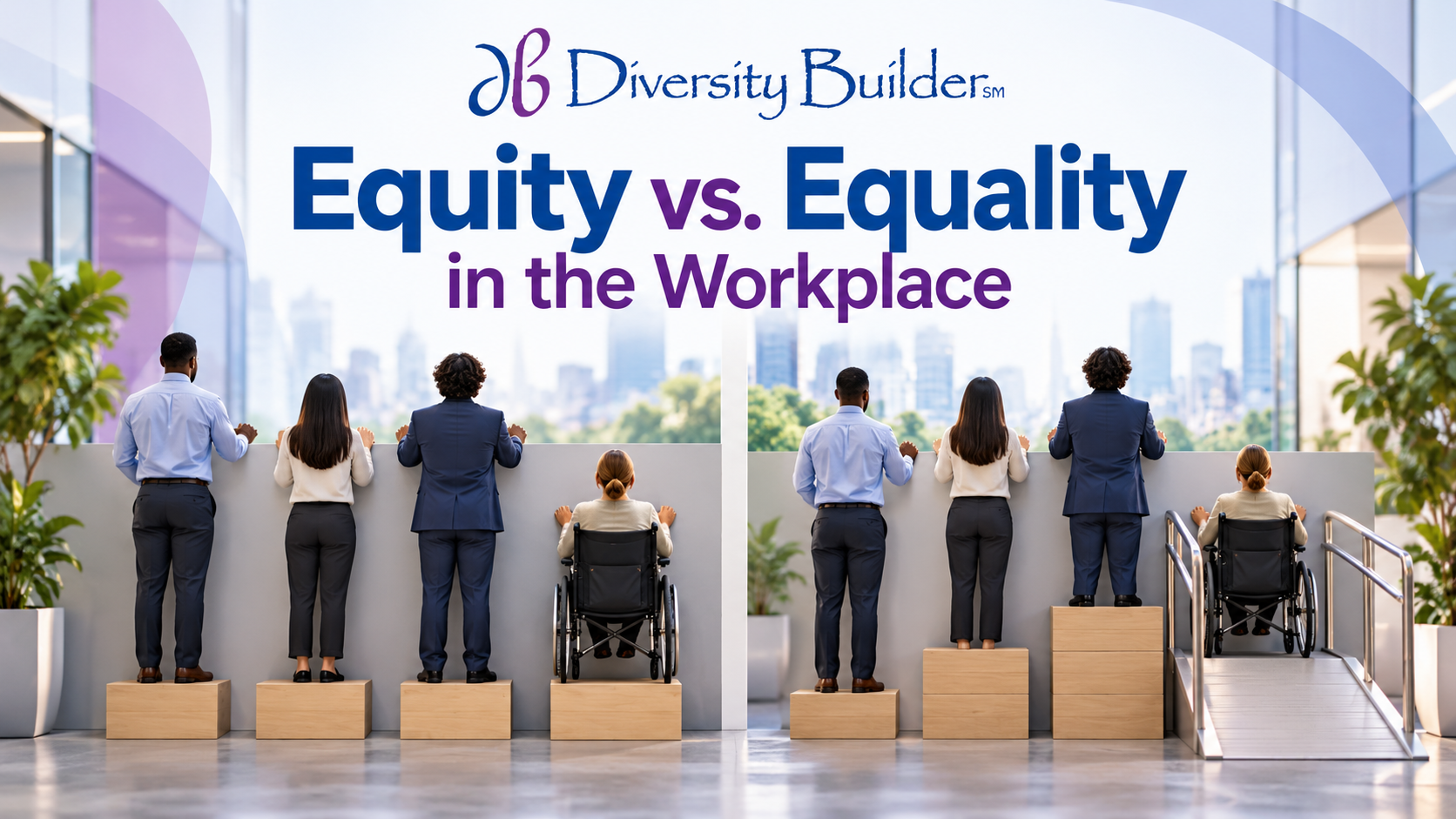
Equity and equality in the workplace both involve fairness, but they approach it differently. Equality means providing employees with the same opportunities, rules, or resources. Equity means recognizing that employees may face different barriers and providing appropriate support so they have a fair opportunity to succeed.
Consider two employees attending the same training session. Both receive identical materials, but one employee uses a screen reader that cannot access the documents. The employer has provided equal materials, yet the employees do not have equal access to the information.
An equitable approach would provide accessible training materials while maintaining the same learning objectives for everyone.
This difference affects everyday decisions about hiring, pay, accessibility, benefits, promotions, and professional development. The following guide explains both concepts, offers practical workplace examples, and outlines ways managers can build fairer processes.
What Is Equality in the Workplace?
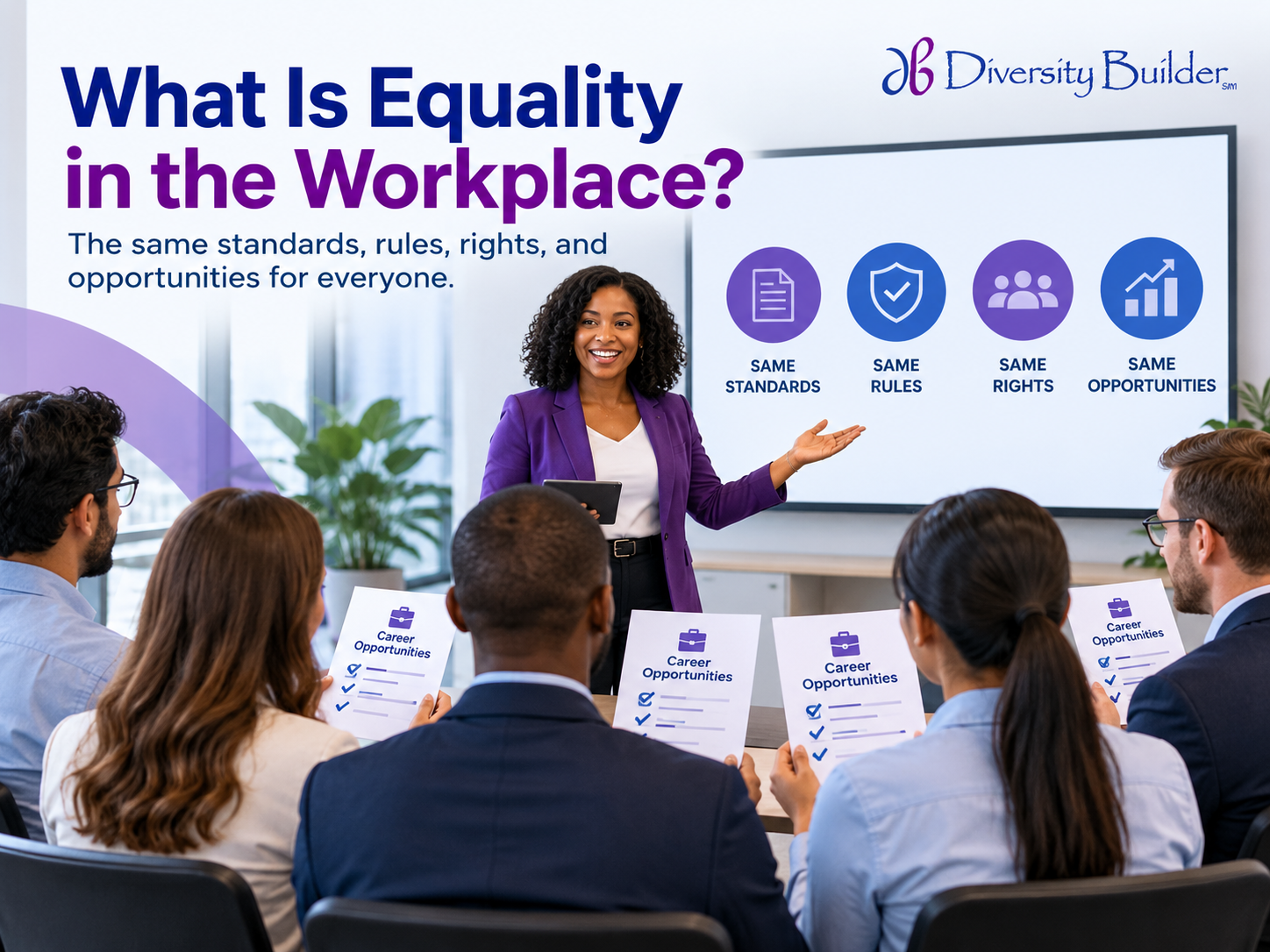
Equality in the workplace means applying the same standards, rules, rights, and opportunities to employees without unfair discrimination.
For example, an employer might establish a clear promotion policy, make job openings available to eligible employees, and assess applicants against the same job-related criteria.
These are examples of equality because everyone can understand the requirements and participate in the process.
Equality is especially important when establishing consistent policies, protecting employees from discrimination, and making employment decisions based on qualifications and performance.
However, identical treatment does not always mean employees can benefit equally from an opportunity.
Suppose a company announces an optional professional development workshop scheduled outside normal working hours. Every employee is invited, but some have caregiving responsibilities or work schedules that prevent them from attending.
The invitation is equal. Access to the opportunity may not be.
This is where equity becomes relevant.
What Is Workplace Equity?
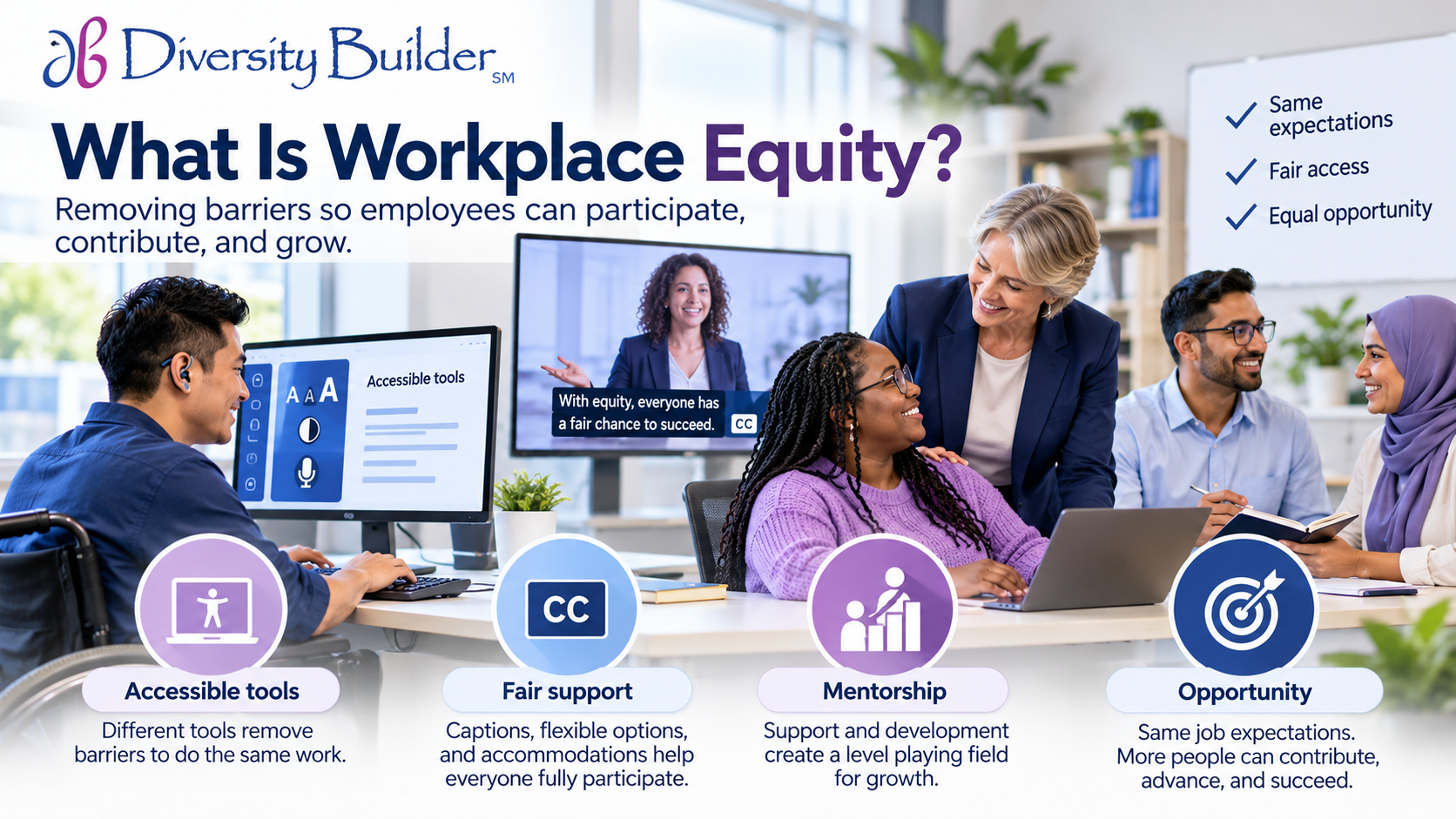
Workplace equity means identifying barriers that affect employees’ ability to participate, contribute, and advance, then addressing those barriers through fair and appropriate workplace practices.
Equity recognizes that people have different circumstances, abilities, resources, and experiences.
An example of equity is providing accessible software to an employee who uses assistive technology. The employee is expected to meet the same relevant job requirements, but the equipment enables them to perform their work effectively.
Workplace equity may involve improving policies that affect many employees or providing individualized support when necessary.
For instance, an organization might:
- Offer accessible training materials and captions for video presentations.
- Schedule learning opportunities across different shifts.
- Establish transparent promotion criteria and communicate them to all eligible employees.
- Consider reasonable workplace accommodations for employees with disabilities.
- Review whether employees have meaningful access to mentorship and professional development.
Equity does not require employers to guarantee that everyone achieves identical results. The goal is to identify and reduce unfair barriers while maintaining legitimate job expectations.
Equity vs. Equality in the Workplace: Key Differences
Both approaches can contribute to a fair workplace. The difference is how they address people’s circumstances.
| Area | Equality | Equity |
| Main focus | Consistent treatment and equal opportunities | Fair access by identifying and addressing barriers |
| Resources | The same resources or opportunities may be offered to everyone | Resources or support may vary according to legitimate needs |
| Policies | Establishes consistent rules and standards | Reviews whether those rules create avoidable barriers |
| Employee development | Makes learning available to eligible employees | Helps employees participate in and benefit from learning |
| Performance | Uses clear job-related expectations | Considers whether employees have the tools and access needed to meet them |
| Desired result | Fair treatment and equal opportunity | Meaningful access to opportunities without unfair barriers |
The simplest difference: Equality asks whether everyone has been offered the same opportunity. Equity also asks whether people can realistically access and use that opportunity.
A sound workplace approach often needs both.
10 Equity vs. Equality Examples in the Workplace
Examples of equity and equality become easier to understand when we look at ordinary workplace decisions.
The following equality vs equity examples cover situations HR managers, supervisors, and employees may encounter. These are illustrative scenarios, not descriptions of actual client cases.
1. Hiring and Recruitment
Equality example: A hiring manager uses the same interview questions and scoring criteria for every candidate applying for a position.
Equity example: The employer keeps consistent, job-related evaluation criteria while providing accessible interview arrangements for applicants who need them. The hiring team also checks whether assessments measure skills required for the job rather than unrelated abilities.
For example, a candidate who uses assistive technology may need an accessible online assessment rather than a system that cannot be operated with their device.
Candidates should still be evaluated on relevant job qualifications.
A structured hiring process can support both consistency and fair access. The U.S. Equal Employment Opportunity Commission (EEOC) explains that employment selection procedures must comply with federal antidiscrimination requirements.
2. Accessibility and Workplace Equipment
Equality example: Every employee receives the same standard desk, chair, and computer setup.
Equity example: Employees receive equipment and workplace adjustments appropriate to their job requirements and accessibility needs.
An employee who uses a wheelchair might need an adjustable-height workstation. Another employee may use screen-reading software or a different input device.
The equipment is different, but the purpose is consistent: enabling qualified employees to perform their jobs.
The Americans with Disabilities Act (ADA) addresses reasonable accommodations for qualified applicants and employees with disabilities, subject to applicable legal requirements.
For employers looking to understand accessibility barriers and inclusive workplace practices, disability inclusion training can help employees and managers strengthen their awareness and decision-making.
3. Employee Training and Professional Development
Equality example: Everyone receives the same training allowance and access to one live workshop.
Equity example: The employer makes training accessible through suitable scheduling, accessible materials, and different participation formats where practical.
An employee working an overnight shift may be unable to attend a workshop scheduled at 10 a.m. An employee who is Deaf or hard of hearing may need accurate captions to follow training videos.
Offering an alternative session or accessible learning resources can help both employees participate.
The learning goals remain consistent even when delivery methods differ.
According to the World Wide Web Consortium’s accessibility guidance, captions and transcripts help make audio and video information accessible to people with different needs.
4. Meetings and Team Communication
Equality example: Every employee receives the same meeting invitation and presentation slides.
Equity example: Meeting organizers consider whether employees can access the discussion, materials, and opportunities to contribute.
This may include sending an agenda in advance, making documents accessible, providing captions, or offering different ways to submit questions.
For example, a team member working remotely should have a meaningful way to participate in a discussion rather than simply being allowed to watch an in-person meeting.
Employees should not need to compete for basic access to information.
Workplace communication practices can be reviewed alongside broader strategies for creating an inclusive workplace.
5. Work Schedules and Religious Observances
Equality example: A company gives every employee the same designated holidays and applies a standard scheduling policy.
Equity example: The employer considers appropriate scheduling flexibility and applicable accommodation requirements when an employee’s religious observance conflicts with work.
For example, an employee may request time off for a religious holiday that is not included in the organization’s standard calendar.
An employer can review the request under its policies and applicable law rather than assuming the standard holiday schedule meets everyone’s needs.
In the United States, Title VII religious accommodation guidance describes an employer’s obligations and the undue-hardship standard.
Equity in scheduling does not mean granting every possible request. It means using a fair process and considering legitimate individual needs.
6. Employee Benefits
Equality example: An employer offers the same benefits package to all employees who meet the eligibility requirements.
Equity example: The organization reviews whether the available benefits and the rules for using them serve employees with different circumstances.
For example, a benefits program might offer choices that allow eligible employees to select options better suited to their circumstances, within the employer’s plan and legal requirements.
Other examples include reviewing leave policies, benefit eligibility, and the accessibility of employee assistance resources.
A company can retain clear, consistent eligibility standards while examining whether its policies create unnecessary barriers.
7. Pay Equity and Compensation
Equality example: Employees performing substantially equal work are protected against unlawful pay discrimination.
Equity example: The employer reviews compensation decisions to identify unjustified differences and uses documented, lawful, job-related factors to make pay decisions.
Pay equity is an area where consistent rules are especially important.
An employer might compare employees performing substantially equal work, examine differences in pay, and determine whether those differences have legitimate explanations.
The EEOC’s equal pay guidance explains that the Equal Pay Act addresses equal pay for equal work between men and women in the same workplace. Other federal laws also prohibit certain forms of compensation discrimination.
Pay equity should not be confused with paying every employee the same amount regardless of role, responsibilities, qualifications, or legitimate performance factors.
8. Performance Evaluations
Equality example: Employees in comparable roles are evaluated against clearly defined performance expectations.
Equity example: Managers maintain legitimate job standards while ensuring employees have appropriate tools, communication, training, and feedback to meet those expectations.
Consider two employees with similar responsibilities. One has regular coaching meetings, while the other receives feedback only during an annual review.
Even if their final evaluations use identical forms, their access to development support has been different.
An employer can improve the process by setting regular feedback expectations, training managers, and documenting performance criteria.
The aim is a more consistent and fair evaluation process, not different performance standards based on assumptions about employees.
9. Promotions and Career Advancement
Equality example: All eligible employees can apply for an open management position.
Equity example: The employer checks whether employees have fair access to the experiences, information, and development opportunities needed to compete for advancement.
For example, promotion criteria might favor employees who have led major projects, but only a small group has been offered those assignments.
HR can review how stretch assignments are allocated, how promotion opportunities are communicated, and whether employees understand the skills required to advance.
A transparent process is a useful starting point.
Unconscious bias training can support conversations about assumptions that influence workplace judgments, while clear policies and accountable management practices address the decisions themselves.
10. Employee Recognition and Rewards
Equality example: A company gives every employee the same type of recognition reward, such as a ticket to a weekend event.
Equity example: The employer offers appropriate reward options so eligible employees can choose something they can use and enjoy.
An employee with a caregiving obligation or accessibility need may find the standard event difficult to attend.
Providing reasonable choices can make a recognition program more useful to employees with different circumstances.
The criteria for earning recognition should remain transparent and job-related.
These examples of workplace equity show how fair support and consistent standards can work together.
When Does Equality Still Matter in the Workplace?
It would be a mistake to assume that equity should replace equality in every situation.
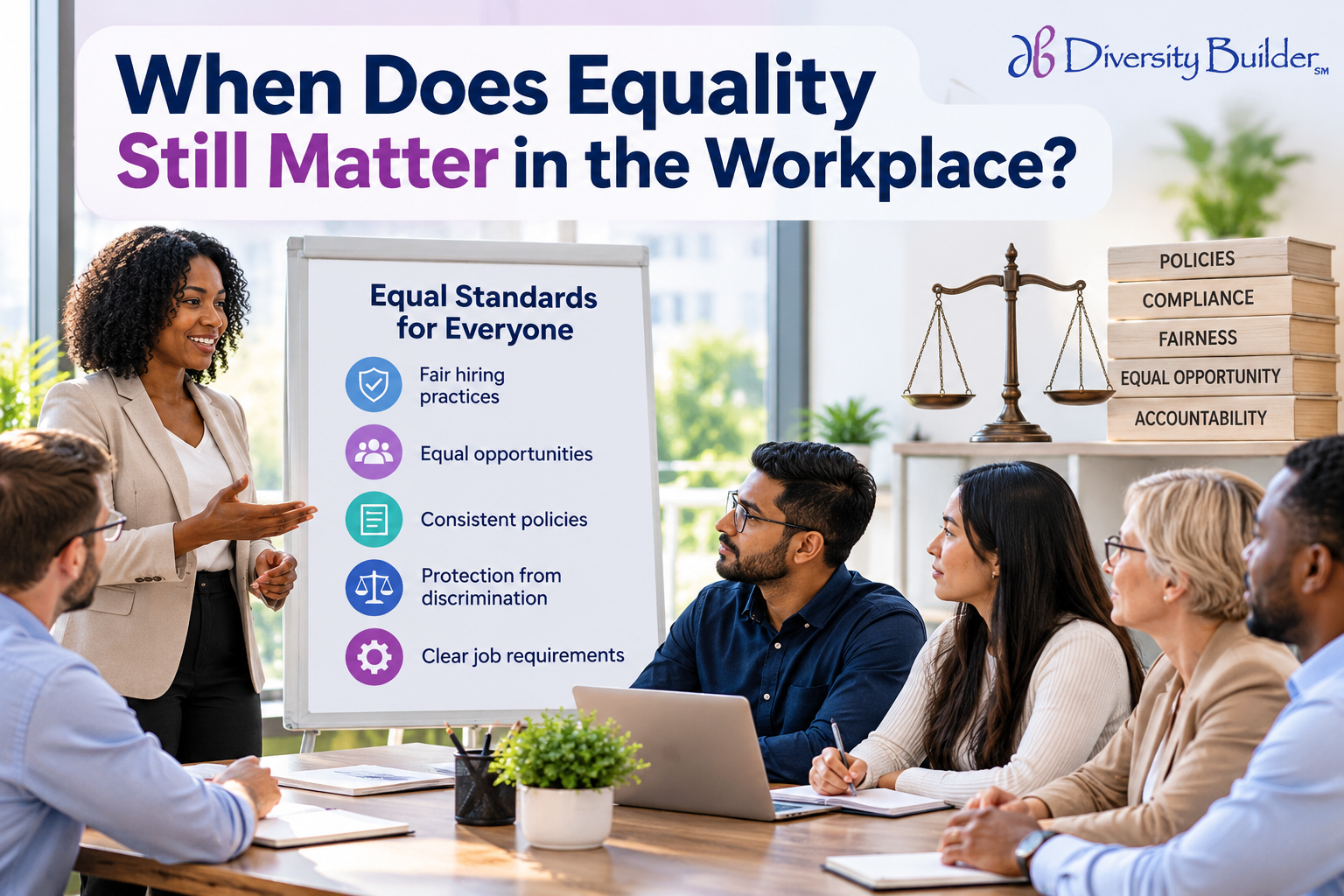
Equality remains essential for workplace rights, consistent expectations, nondiscrimination, and transparent employment decisions.
Employers need dependable standards for matters such as:
- Workplace safety and conduct policies.
- Protection against discrimination and harassment.
- Clearly communicated job requirements.
- Transparent eligibility and evaluation criteria.
- Fair compensation practices consistent with applicable law.
For example, an employer should not remove legitimate safety requirements simply to make outcomes identical. Instead, it can consider whether appropriate adjustments allow employees to satisfy essential requirements safely.
Similarly, making reasonable accommodations does not generally mean eliminating the essential functions of a job.
The EEOC’s ADA employer guidance explains how reasonable accommodations and essential job functions are addressed.
The important question is not whether equality or equity wins. It is how employers can maintain fair standards while removing barriers that prevent qualified people from participating.
Why Does Workplace Equity Matter?
Workplace equity matters because an opportunity that exists on paper may not be usable by everyone in practice.
Employees Can Access Opportunities More Fairly
A training program may be available to everyone, but employees on different schedules or those who need accessible materials may be unable to participate.
Reviewing these barriers can help employers make development opportunities more accessible.
Managers Can Make Better-Informed Decisions
A manager who understands equity is more likely to ask whether a workplace process is fair in practice.
For example, instead of assuming that an employee lacks interest in advancement, the manager can examine whether the employee has received information about development opportunities and the qualifications for promotion.
Organizations Can Identify Problems in Their Systems
Fairness concerns are not always the result of one person’s decisions.
Sometimes the issue comes from a policy, a scheduling practice, inaccessible technology, or unclear expectations.
Addressing such barriers can improve access and create more consistent workplace experiences.
There is also an important distinction between equity, equality, diversity, and inclusion.
Diversity concerns differences and representation among people. Inclusion concerns meaningful participation and belonging. Equality addresses fair treatment and opportunities. Equity examines the barriers that may affect access to those opportunities.
Each concept answers a different question about workplace culture.

How to Improve Equity at Work: 6 Practical Steps
Employers don’t need to redesign every policy at once. A more manageable approach is to select a specific workplace process, find out where access is breaking down, and make improvements.
Step 1: Review Existing Workplace Policies
Start with hiring, onboarding, training, performance evaluations, scheduling, and promotion procedures.
Ask whether the written policy gives employees a fair opportunity to participate and whether it works as intended.
Look for requirements that may be unrelated to the actual job or create unnecessary barriers.
Step 2: Listen to Employees
Invite feedback about employee experiences and barriers.
Anonymous surveys, accessible feedback channels, and structured discussions can help identify issues that are not visible in written policies.
Avoid assuming that employees with similar backgrounds all have the same needs.
Step 3: Identify Barriers in Everyday Processes
Consider where employees encounter difficulties accessing information, training, equipment, and development opportunities.
For example, a team may discover that important learning sessions are consistently scheduled during the working hours of one department but not another.
Document the specific issue before deciding on a solution.
Step 4: Apply Fair, Job-Related Standards
Clear criteria are important for hiring, promotions, rewards, and performance evaluations.
Use consistent processes and make appropriate, lawful adjustments when needed.
Employment decisions must follow applicable nondiscrimination and accommodation requirements.
Step 5: Train Managers to Recognize Barriers
Managers frequently decide who gets assignments, development opportunities, support, and feedback.
Training can help them ask better questions, recognize assumptions, respond respectfully to employee concerns, and work with HR on appropriate solutions.
Diversity Builder offers workplace diversity training programs using facilitated discussions, workplace scenarios, and practical learning activities.
Training works best when organizations also examine the policies and decisions that influence employees’ experiences.
Step 6: Review Results and Make Adjustments
Choose a few useful indicators and establish a baseline.
Review progress over time and ask employees whether changes have improved access.
If a policy has not addressed the original barrier, revise it rather than assuming the first solution was sufficient.
How Can HR Measure Workplace Equity?
Measuring workplace equity involves examining both access to opportunities and the experiences of employees.
A practical starting point is to evaluate processes that the organization already tracks.
| Area | What HR Can Review |
| Hiring | Candidate participation, assessment accessibility, and job-related selection criteria |
| Training | Who can access and complete development opportunities across roles and shifts |
| Promotion | Eligibility, access to key assignments, and application and selection processes |
| Compensation | Pay differences for comparable work and documented explanations |
| Employee experience | Feedback about fairness, accessibility, and support |
Where lawful and appropriate, employers may also review aggregated data to understand whether certain groups experience consistent barriers. Employee privacy, confidentiality, and proper data handling remain essential.
Data alone does not explain why a difference exists. HR should investigate the circumstances before drawing conclusions.
Common Mistakes When Applying Equality and Equity
Assuming Identical Treatment Is Always Fair
A policy can apply equally to everyone and still create avoidable obstacles for some employees.
Managers should consider whether employees can realistically access the opportunity being offered.
Assuming Different Support Means Lower Standards
Providing accessible equipment, alternative training formats, or reasonable accommodations does not automatically change the legitimate requirements of a job.
The objective is to make participation possible while preserving appropriate standards.
Making Assumptions About Individual Needs
An equitable approach should not rely on stereotypes about age, disability, religion, gender, or other personal characteristics.
Listen to employees, use objective information, follow applicable policies and law, and respond to actual barriers.
Treating Training as the Only Solution
Workplace training can improve understanding and communication, but it cannot fix an inaccessible hiring platform or an unclear promotion policy by itself.
Employers also need to review systems, manager practices, and procedures.
A Quick Equity Check for Managers
Before making a workplace decision, consider four questions:
- Is the standard fair and job-related? Make sure the policy or expectation serves a legitimate purpose.
- Can employees realistically access the opportunity? Consider equipment, schedules, communication, and accessibility.
- Are we making assumptions about someone’s needs? Ask appropriate questions rather than relying on stereotypes.
- Can we explain and document the decision? Make sure the process is transparent, consistent, and compliant with applicable requirements.
These questions can help managers distinguish between legitimate differences in support and inconsistent or unfair treatment.
Frequently Asked Questions
What is the difference between equity and equality in simple terms?
Equality means providing the same treatment or opportunities. Equity means considering whether people face different barriers and providing appropriate support to improve fair access. Both can be necessary in a workplace.
What are examples of equity in the workplace?
Examples of equity include accessible workstations, captions for employee training, reasonable accommodations, flexible ways to participate in development programs, and transparent access to promotion opportunities.
These examples of equity focus on removing barriers rather than guaranteeing identical outcomes.
What are examples of equality at work?
Examples of equality include applying nondiscrimination policies consistently, using job-related hiring standards, making positions available to all eligible employees, and providing equal pay protections under applicable law.
Is workplace equity the same as giving employees special treatment?
No. Workplace equity focuses on fair access and appropriate responses to genuine barriers. An adjustment should have a legitimate basis and comply with applicable workplace policies and laws. Equity does not automatically justify preferences based on protected characteristics.
Does equity mean everyone must achieve the same result?
No. Employees may make different choices or achieve different outcomes for many legitimate reasons. Workplace equity focuses on whether unfair barriers limit access to opportunities, resources, or participation.
Can a company practice both equality and equity?
Yes. An employer can use consistent job requirements and nondiscrimination rules while providing reasonable accommodations and accessible resources. Equality and equity can support one another.
What is an example of equity versus equality in employee training?
Equality would be offering every employee the same training session. Equity could include providing accessible materials, appropriate captions, or additional scheduling options so employees can participate while working toward the same learning objectives.
Build a Workplace Where Fair Opportunities Are Accessible
Understanding the difference between equality and equity is a useful starting point. The next step is to examine how employees experience everyday workplace practices.
A policy might be consistent but difficult for some employees to access. Another process may offer flexibility but lack clear standards. Addressing both issues helps organizations make more thoughtful decisions.
Diversity Builder, Inc. offers customized workplace training for employees, managers, and organizational leaders. Its programs use interactive discussions, practical workplace scenarios, and facilitated learning to help teams strengthen communication, respect, and inclusive practices.
Organizations interested in exploring these topics can learn more about workplace training options or contact Diversity Builder to discuss their goals.
Call (615) 823-1717 or complete a training inquiry through Diversity Builder.