
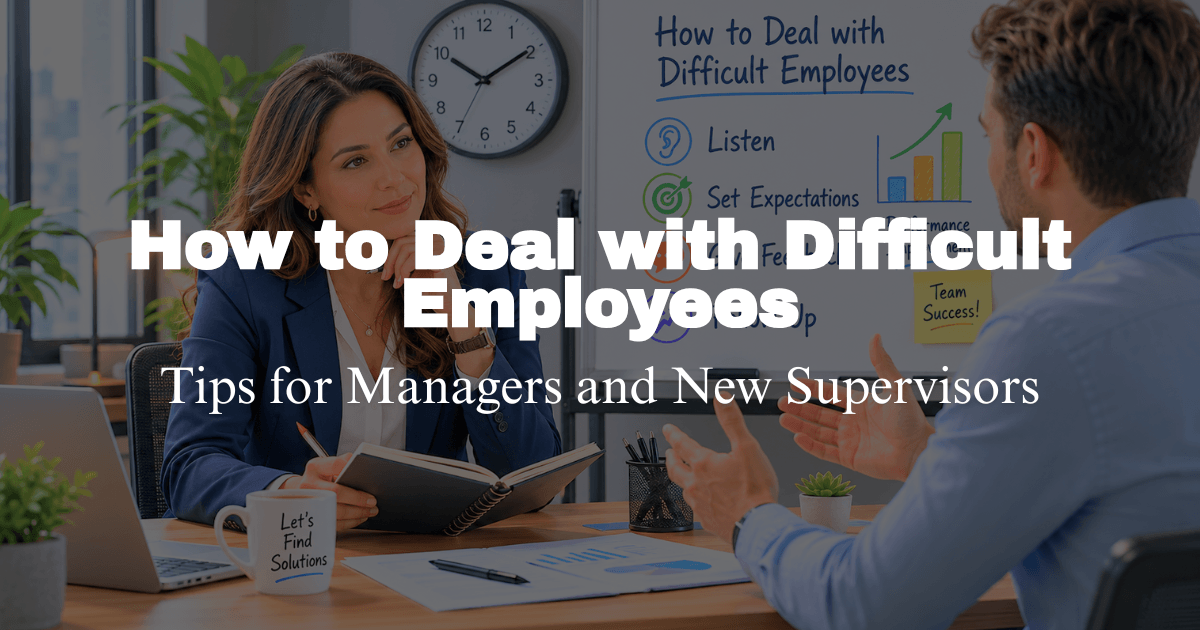
People often use the term difficult employees to describe managers or employees who display challenging behaviors in the workplace.
It is best to avoid the term difficult employee altogether, as it is considered both derogatory and labeling. Instead talk about the behaviors a “difficult employee” exhibits.
Examples of difficult behaviors at work:
- Interrupting people
- Not practicing active listening
- Lacking a filter when talking
- Not taking accountability
- Complaining
- Gossiping and other toxic behaviors
To deal with a difficult employee situations, address the behavior early and privately, describe the specific actions (not the person) using a model like Situation-Behavior-Impact, listen to understand the root cause, set clear expectations in writing, offer support such as coaching, and follow up, escalating to HR when conduct violates policy or law.
Key Takeaways
- Act early. Most difficult employee situations are solved by a prompt, private conversation, not a formal process. Waiting lets the behavior spread and quietly lowers the bar for everyone else.
- Address specific behaviors rather than letting it be personality-based. Name the specific action and its impact (the Situation-Behavior-Impact model) so feedback stays honest, transparent, fair and reasonable to accept.
- Follow the six-step sequence: address it privately, describe the behavior, listen for the root cause, set written expectations, offer real support, then follow up.
- Match the response to the type. The chronic complainer, underperformer, know-it-all, resistor, gossip, bully, and quiet quitter each needs a slightly different first move.
- New managers earn respect through consistency, not force. Listen first, apply the same standard to everyone, and follow through on every commitment.
- Handle disrespect calmly and immediately. State that respect goes both ways, give the person room to explain, and document each instance if it becomes a pattern.
- Know your red lines. Loop in HR right away for harassment, discrimination, threats, or safety issues. For ordinary performance problems, follow progressive discipline (verbal, written, PIP, then termination).
- Prevention beats correction. Clear expectations, continuous feedback, psychological safety, and trained managers stop most problems before they start.
Training to Address a Toxic Work Environment
Almost every manager inherits one: the team member who misses deadlines, bristles at feedback, undermines meetings, or makes the room tense. If you are a new supervisor, the challenge can feel even sharper. You are still establishing authority while trying to correct someone else’s behavior. The instinct to wait it out is understandable, but it is also expensive.
Gallup estimates that voluntary turnover costs U.S. businesses roughly $1 trillion a year, and that replacing a single employee can run from one-half to two times their annual salary. A single disengaged team member does not just cost productivity. The negativity spreads. This guide gives you a practical, repeatable way to handle difficult employees with fairness and confidence.
By the numbers
| $1T | Estimated annual cost of voluntary turnover to U.S. businesses |
| 70% | Of the variance in team engagement is attributable to the manager |
| 15% | Of employees worldwide are actively disengaged, and likely to spread it |
| ~34% | Of annual salary is what a disengaged worker can cost an employer |
How do you deal with a difficult employee situation?
In short: Address an employee showing difficult or challenging behaviors with early intervention, focusing on observable behaviors that are documented, if possible. Set up a program that includes both accountability and support, with possibly a mentor assigned. Specific and measurable behavior expectations are key when documenting and meeting with the employee to discuss improvement. The proven sequence is: (1) address the situation privately, (2) describe the specific behaviors and how they are unwelcome and harmful (refer to harassment policy and employee handbook, if available), (3) listen for life or work changes that may have contributed to the changed behavior, (4) set written expectations, (5) offer help, and (6) follow up, involving HR when policy or legal lines are crossed.
The mistake most managers make is not preparing . It is waiting too long to say anything. Difficult behavior rarely corrects itself, and the longer it continues, the more your best people quietly recalibrate what is acceptable. Researchers at the Center for Creative Leadership have found that leaders who consistently address employees who exhibit difficult or challenging behaviors tend to build stronger overall teams and show higher performance metrics than those who avoid employee conversations. The rest of this guide describes each recommended step, plus the specific employee types/behaviors and scenarios which are most common in the workplace.
What makes an employee difficult?
Again it is not a difficult employee; it is difficult or challenging behaviors. This occurs when an employee displays inappropriate, unwelcome, and often toxic behaviors at work. Instead of referring to the person as a difficult employee, review and focus on the specific behaviors that are unwelcomed and harmful. Patterns such as poor performance, resistance to feedback, low collaboration, chronic negativity, or disrespect that disrupt the comradery and collaboration within a team. Naming the behavior (rather than labeling the person) is the first step toward resolution.
Before you can address a problem, you have to define it precisely. Vague frustration (she has a bad attitude) rarely changes anything. Documented behavior (she interrupted two colleagues and dismissed the project plan in Tuesday’s meeting) gives you something concrete and fair to work with. Common categories of difficult behavior include:
- Underperformance: missed deadlines, low output, repeated errors.
- Resistance to feedback: defensiveness, excuses, or denial when coached.
- Low collaboration: refusing tasks, isolating others, withholding information.
- Ongoing negativity: complaining, gossip, or undermining morale.
- Disrespect or insubordination: ignoring direction, talking over leadership, hostility.
Keeping the focus on behavior protects you, too. It keeps the conversation professional, reduces the risk of bias, and creates the documentation you will need if the situation escalates.
What are the 7 most challenging employee types in the workplace?
The seven most challenging employee types are the chronic complainer, the underperformer, the know-it-all, the resistor, the gossip, the bully, and the disengaged “quiet quitter.” Each calls for a slightly different response, but all respond best to early, behavior-specific conversations.
Recognizing the pattern helps you choose the right approach. Use the table below as a quick diagnostic, then apply the step-by-step framework that follows.
| Employee behavior | What it looks like | Best first move |
| 1. Chronic Complaining (leading to toxic work environment) | Finds fault constantly; drains energy without offering solutions. | Acknowledge the concern, then redirect: What would you change and how? |
| 2. Underperforming | Misses goals or deadlines despite clear expectations. | Separate “can’t” from “won’t”; clarify expectations and check for barriers. |
| 3. Difficulty Listening and Learning from Others | Dismisses input, dominates discussion, resists collaboration. | Channel the confidence: assign ownership, but require they solicit input. |
| 4. Resistant to Change | Pushes back on every change or new process. | Explain the why, involve them early, and name the behavior if it persists. |
| 5. Gossips about Other Team Members and Departments | Spreads rumors; erodes trust across the team. | Address privately and directly; reinforce confidentiality expectations. |
| 6. Displays Bullying Behaviors | Intimidates, belittles, excludes, makes fun of, or undermines coworkers. | Act immediately. This can cross into harassment. Document and loop in HR. |
| 7. Disconnected from the Team | Disengaged; does the minimum and withdraws. | Reconnect to purpose; ask what changed and what support is missing. |
How to handle a difficult employee situations: a step-by-step guide
These six steps work for nearly every scenario above. They move from the least formal (a private conversation) to the most formal (HR and corrective action), so you always start proportionate to the problem.
Step 1: Address it early and in private
Schedule a talk with the employee as close to the time of the incident(s) causing concern. Request a private one-on-one promptly. Early conversations and follow-up discussions often resolve issues without formal performance plans.
Step 2: Focus on behavior, not character
Use the Situation-Behavior-Impact (SBI) model developed by the Center for Creative Leadership: name where it happened, what the person did, and the effect it had. It keeps feedback clear and believable, as it is tied to actual incidents.
Example of Employee Feedback
“In yesterday’s planning meeting (situation), you interrupted Maria twice and said the timeline was ‘a waste of time’ (behavior). It shut down the discussion, and Maria did not share the rest of her plan (impact). Can we talk about what was going on?”
Step 3: Listen for the root cause
Harvard’s Program on Negotiation advises managers to actively listen to learn before correcting. Difficult behavior is often a symptom of an unclear role, burnout, a personal issue, or a process problem you can fix. Ask open-ended questions to explore reasons for the change and let them answer fully before you respond.
Step 4: Set clear expectations, in writing
State exactly what needs to change, by when, and what this change looks like. Then summarize the conversation in a short follow-up email. Consistent and specific documentation is important to clearly describe the issue and establish accountability with action items and measurement of results. If you do have to involve human resources (HR) at some point and build a Performance Improvement Plan (PIP), the details will be easily accessible.
Step 5: Offer genuine support
Pair accountability with help: training, mentoring, a temporary check-in cadence, and/or coaching all lead to positive outcomes in most cases. If performance is the issue, a structured Performance Improvement Plan (PIP) sets measurable goals with a timeline. Many “difficult” employees simply lack a skill or a clear target.
Step 6: Follow up, and escalate when needed
Behavior change takes repetition. Check in on the dates you set, recognize genuine improvement, and be honest when it is not happening. If the behavior continues despite support, or crosses a legal or policy line, move to formal corrective action with HR.
| Give your managers the conversation skills they’re missing
Most managers were never trained to have these conversations. Diversity Builder’s live, trainer-led Conflict Resolution Training for Leaders and Having Difficult Conversations workshops build exactly these skills, onsite or by webinar. |
How do you deal with difficult employee scenarios as a new manager?
As a new manager, deal with difficult employees by establishing authority through consistency, not force. Listen first to build credibility, apply rules fairly to everyone, address issues promptly, and coach in private. Respect is earned by following through, not by coming in heavy-handed.
New supervisors face a unique bind: you need to correct behavior before you have fully earned the team’s trust. The temptation is to over-assert (“I’m in charge now”) or to avoid conflict entirely so people will like you. Both backfire. Instead:
- Lead with questions. Asking what is getting in someone’s way signals confidence, not weakness, and surfaces problems you can actually solve.
- Be consistent. Applying the same standard to everyone is the fastest way for a new manager to earn respect.
- Follow through. If you promise support or set a consequence, deliver it. Credibility is built on the gap between what you say and what you do.
- Coach privately, recognize publicly. Never correct someone in front of peers; it breeds resentment and fear.
How do you handle a difficult employee scenarios who doesn’t respect you?
Handle a disrespectful employee by addressing it calmly and immediately. Name the specific behavior, state your expectation clearly (I’ll always treat you with respect and I expect the same), give them a chance to explain, document the conversation, and apply formal consequences if it continues.
Disrespect and insubordination are corrosive precisely because the whole team is watching how you respond. Do not take the bait emotionally, but do not ignore it either. Address it the moment it is reasonable to do so, in private.
Try saying
When I gave that direction in the meeting, you rolled your eyes and said Whatever.’ I want to understand what is going on, but I also need to be clear: I will always treat you with respect, and I expect the same in return. That kind of response is not okay here.
Give them room to respond. Sometimes there is a legitimate frustration underneath. But if the disrespect is a pattern, name it as such, document each instance, and move into your organization’s formal warning process. Tolerating insubordination once tends to invite it again, so it is better to address it early and consistently.
How do you handle employees with bad attitudes?
Handle a bad attitude by treating it as a behavior problem with consequences, not a personality flaw. Identify the specific actions (gossip, negativity, sighing, dismissiveness), explain their impact on the team, reinforce positive behavior, and set clear expectations, documenting if it persists.
“Attitude” feels impossible to address because it sounds subjective. The fix is to translate it into observable behavior. You cannot coach be more positive,” but you can address, commenting that a project is pointless in front of the team. Once you have named the behavior, explain why it matters. Negativity is contagious and measurably lowers team morale. Acknowledge the version you want to see more of when it appears. If it continues after a clear conversation, document it and treat it like any other performance issue.
When should you involve HR or consider termination?
Involve HR when behavior violates policy or law (harassment, discrimination, threats, safety issues), when you are moving to formal warnings or a PIP, or when coaching has not worked. Termination is a last resort that follows documented warnings, except for serious misconduct, which may require immediate action.
Most difficult employee situations never need HR. Some need it immediately. Learn to tell the difference. Loop in HR early when any of these “red lines” appear:
- Harassment, discrimination, or retaliation under laws like Title VII or the ADA.
- Threats, violence, or any safety risk.
- Conduct that could create a hostile work environment.
- Anything involving a protected category or a possible legal claim.
For ordinary performance and behavior issues, follow your company’s progressive process: typically a verbal warning, then a written warning, then a Performance Improvement Plan, and only then termination if there is no improvement. In the U.S., most employment is “at-will,” but consistent documentation and fair, non-discriminatory treatment still matter enormously if a decision is ever challenged.
This article is for general guidance and is not legal advice. Employment laws vary by state and situation. Consult your HR team or an employment attorney before taking disciplinary or termination action.
How do you answer ‘How do you deal with difficult employees? in an interview?
Answer this interview question with a structured story: briefly describe the situation, your approach (listen, give behavior-specific feedback, set expectations, offer support), and the positive outcome. Use the STAR format and emphasize empathy, fairness, and follow-through.
Hiring managers ask this to see whether you can hold people accountable and keep a relationship intact. Do not describe yourself as someone who “doesn’t tolerate problems.” Show judgment. A strong answer sounds like this:
Sample answer
“I start by understanding the cause rather than assuming. On one team, a strong performer became withdrawn and short-tempered with colleagues. In a private one-on-one, I learned he felt passed over for a project. I acknowledged it, set clear expectations about how we communicate, and gave him ownership of a new initiative with regular check-ins. Within two months, his engagement and his relationships with the team were back on track.”
Notice the shape: empathy first, then clear expectations, then a concrete, positive result. That balance of decisiveness and care is exactly what employers are listening for.
How do you prevent difficult employee behavior before it starts?
Prevent difficult behavior by building a culture of clear expectations, regular feedback, and psychological safety. Train managers in communication and conflict skills, run anonymous engagement surveys, and address small issues before they calcify. Prevention is far cheaper than correction.
The most effective managers spend less time managing difficult employees because they build conditions where fewer problems take root. Because managers account for roughly 70% of the variance in team engagement, investing in their skills has an outsized effect. Practical moves that prevent problems:
- Set expectations on day one. Clarity prevents most “attitude” issues.
- Give feedback continuously, not once a year, so small course corrections stay small.
- Build psychological safety so people raise concerns instead of acting them out.
- Train your managers in feedback, conflict resolution, and emotional intelligence.
- Listen to the data. Anonymous engagement surveys flag friction early.
| Turn a difficult situation around with targeted coaching
When one employee’s behavior puts the team or the organization at risk, Diversity Builder offers confidential, time-sensitive employee and executive coaching, plus group programs in Respect in the Workplace, Civility, and Emotional Intelligence. |
Frequently asked questions
What are examples of difficult employee behaviors?
Common examples include poor performance and missed deadlines, resistance to feedback, refusing to collaborate, chronic complaining or gossip, and disrespect or insubordination. Focusing on the specific behavior, rather than labeling the person, makes it easier to address fairly.
How do I communicate when an employee is showing difficult behaviors?
Have a private, calm conversation focused on specific behaviors, not personal attacks. Use concrete examples, describe the impact, and ask open questions like “Can we talk about what’s going on?” Listen fully before responding, and summarize agreed next steps in writing.
What if the employee doesn’t respect me as a manager?
Approach it immediately and calmly. Name the specific behavior, state that you’ll treat them with respect and expect the same, and give them room to explain. Document each incident, and move to formal warnings with HR if the disrespect continues.
When should I involve HR about a difficult employee scenario?
Involve HR whenever behavior may violate policy or law, such as harassment, discrimination, threats, or safety issues, or when you’re moving to formal warnings or a Performance Improvement Plan. Keep written records of what happened and the steps you’ve already taken before escalating.
What should I NOT do when dealing with a difficult employee situation?
Don’t ignore the problem or let it drag on, don’t criticize the person’s character instead of their behavior, don’t give vague feedback, and don’t lose your temper or correct someone in front of the team. And never skip documentation.
How can a new manager build trust while managing difficult employees?
Balance firmness with empathy. Listen first, apply rules consistently to everyone, follow through on every commitment, and coach in private while recognizing good work publicly. Consistency and follow-through earn respect faster than authority ever does.
About the author
Lead Trainer & Workplace Conflict Specialist, Diversity Builder, Inc.
Our trainers design and deliver Diversity Builder’s leadership, conflict resolution, and communication programs for organizations across the United States. They have trained managers and executives in handling difficult conversations, performance issues, and respectful workplace standards. Meet the Diversity Builder team.
References
- This Fixable Problem Costs U.S. Businesses $1 Trillion. gallup.com
- State of the American Manager/employee engagement research (managers drive ~70% of the variance in team engagement). Gallup.
- State of the Global Workplace: 2024 Report (engagement, active disengagement, and salary-cost figures). Gallup.
- Center for Creative Leadership. The Situation-Behavior-Impact (SBI) feedback model and research on addressing difficult employees
- Program on Negotiation, Harvard Law School. Managing Difficult Employees: Listening to Learn. harvard.edu
- Society for Human Resource Management (SHRM). Toolkit: Managing Difficult Employees and Disruptive Behaviors, and cost-of-hire data. org